Knowledge base
Why Is My Snow Machine Producing Water Instead of Snow?
Writer: admin Time:2026-09-16 10:49:37 Browse:0℃
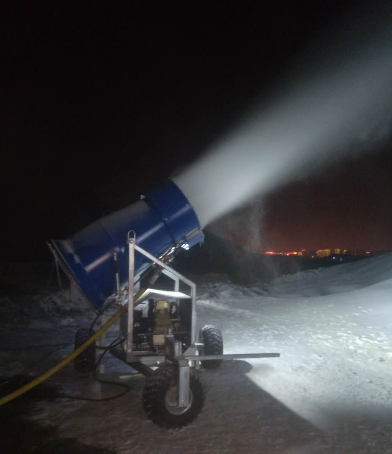
When a snow machine sprays water instead of snowflakes, it is usually caused by equipment operating parameters or environmental conditions failing to meet the required standards. A snow machine does not simply "spray water to make snow"—it needs to atomize water into micron-sized droplets, which then rapidly freeze and crystallize in a low-temperature environment. If the output is water rather than snow, the core reasons generally fall into the following three categories:
1. Ambient Temperature and Humidity Not Meeting Requirements
This is the most common cause. Snow machines have strict requirements for "wet-bulb temperature." Typically, the ambient temperature needs to be below -2°C to -5°C, and the lower the air humidity, the better. If the temperature is close to 0°C or the air humidity is too high, the atomized water mist will not have enough time to freeze in mid-air, naturally resulting in water when it hits the ground.
2. Imbalanced Water Pressure and Air Pressure Ratio
Snow machines rely on high-pressure water and compressed air to mix and atomize at the nozzle. If the water pressure is too low, the water cannot be broken down into fine mist and is instead ejected in the form of water droplets. Alternatively, if the air compressor does not supply enough air, the atomization effect will be poor, resulting in oversized water droplets that cannot fully freeze during their descent.
3. Clogged Nucleator or Nozzles
The "nucleator" inside the snow machine is responsible for generating ice crystal nuclei. If the nucleator becomes clogged or damaged, the water loses its crystallization center. In addition, if the nozzles are blocked by scale or impurities, it will lead to uneven water spraying, forming streams of water instead of a fine snow mist.
Recommended Solutions
First, confirm whether the ambient temperature meets the snow-making conditions. Second, check whether the water pump pressure and air compressor readings are within the standard range. Finally, clean the nozzles and filters. If the parameters are normal but the machine still produces water, it is recommended to contact the manufacturer to inspect whether there is a refrigerant shortage or a fault with the internal solenoid valve or compressor.
CATEGORIES
LATEST NEWS
CONTACT US
wechat: 15612167779
Phone: 15612167779
Email: info@snowcome.com
facebook:
Add: No. 3-1, Daqing Street, Aimin District, Mudanjiang City, Heilongjiang Province